Huom. etikkahappo C2:0 ei katsota rasvahapoksi! Siitä tehdään kehossa rasvahapot lisäämällä niitä tarpeaksi peräkkäin. Propionihappo kehossa on jätetuote joka jää jäljelle pitkistä parittomista rasvahapoista tai joistain aminohapoista ja voidaan uudestaan alkaa kasvattaa 5, 7, 9 jne kokoon lisäämällä 2- hiilen etikkahappoja.
joitain lyhyehköjä parittomia rasvahappoja tulee ihmisenkin ainenenvaihdunnassa siten, että betaoksidaation pätkiessä
rasvahappoja takaisin kahden hiilen pätkinä jää lopulta pariton
kolmenhiilen pätkä, propionihappo ja jos sattuu olemaan tarvetta tai
synteesihenki on päällä, siihen alkaa lisäytyä 2 hiilen pätkiä ja niin
saadaan uusia parittomia kokoja kehoonkin pieni määrä. Niiden loppupätkän
oksidaatio vaatii mm. B12 vitamiinin avulla tapahtuvaa struktuurin
muokkausta soveltuvaksi, jota se voitaisiin syöttää sitruunahappokiertoon portista, jonka nimi on
meripihkahappo.
Kehon fundamentaalijärjstelmä on hyvin tiukka eikä tallainen kemiallinen lista. Joka vaiheella on oma entsyyminsä. niin rakentamisessa kuin purkamisessa. Paras normalisoija konesitoon on liikunta, raikas veden ja kohtalainen energian ja ravintoaineiden käyttö. Paljon muuta ei voi tehdä asian hyväki. varinainen dieetin kvalitatiivine modifiointi omaa vain raajllisen merkityksen ( jos merkitsevästi mitään- vaikka tiede koettaa löytää asian merkitsevyytä yhä uudestaan. Ilman raikkaan veden käyttöä ja liikuntaa rasvakvalitetti ravinnossa ei pääse oikeuksiinsa.
Englantilaisesta tekstistä löytyy viitauksia erilaisiin kliinisiin tiloihin. nervonihapon madaltunut pitoisuus liittyy eräisiin neuropsykiatrisiin tiloihin niiden tietojen mukaan. Nervonihappoa pitäisi muodostua öljyhappolinjasta: C18:1 elongaatiotietä . Kuten taas tiedetään, öljyhappo voi altistua monenlaiselle kohtalolle , muulle kuin tavalliselle elongaatiolle, joten " nervonihapon puute" voi johtua jostain yleisemmästä rasvahappoja kohtaavasta häiritötilasta metaboliassa, arvelen, eikä "nervonihapon puute" ole varmaan mikään tauti sinänsä tai puutostila sinänsä. Tästä pitää odotella lisäselvityksiä, jos löytyy.
OLENNAISTA ja tärkeää tietoa nervonihapon synteesistä: Kannattaa katsoa tämä tieto.
Nervonic acid is a long chain unsaturated fatty acid that is enriched in sphingomyelin.
It consists of choline, sphingosine, phosphoric acid, and fatty acid.
Nervonic acid
may enhance the brain functions and prevent demyelination (Chemical
Land21). Research shows that there is negative relationship between nervonic acid and obesity-related risk factors (PMID: 16394593).
Demyelination in adrenoleukodystrophy (ALD) is associated with an
accumulation of very long chain saturated fatty acids stemming from a
genetic defect in the peroxisomal beta oxidation system responsible for
the chain shortening of these fatty acids.
Sphingolipids from post
mortem ALD brain have decreased levels of nervonic acid, 24:1(n-9), and increased levels of stearic acid, 18:0. (PMID: 8072429).
Tämä muoto kaavassa on sikäli edullinen että siihen voi verratt PUFA rsvahappojen kavoja ja sitten voi katsoa, vaikuttavatko PUFA-alueen entsyymit jotain tähän happoon. ja mitä. Tietysti tämä hahmo vaatii kyllä jonkin ympäristövaikutuksen( ympärilläolevien rasvahappojen vaikutuksen ) taipuakseen tuolla tavalla kulmassa - pohdin vain.
Tämä rasvahappo vaatii oksidaatiossaan alfa-oksidaation, mistä voi tulla jollekin yksilöille ongelmaa alfa-oksidaation heikkouden takia. se vaatii peroksisomaalisen oksidaation. https://www.ncbi.nlm.nih.gov/pubmed/11104019
Tällä rasvahappomuodolla näyttää oelvan useampiakin merkityksiä tautipuolella.
http://www.hmdb.ca/metabolites/HMDB0039540
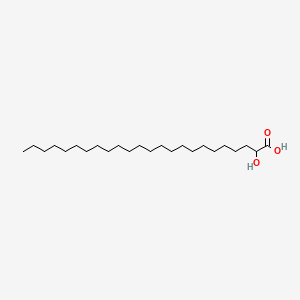
DL-Cerebronic acid, also known as acide cerebronique or cerebronsaeure,
belongs to the class of organic compounds known as very long-chain fatty
acids. These are fatty acids with an aliphatic tail that contains at
least 22 carbon atoms.
DL-Cerebronic acid is considered to be a
practically insoluble (in water) and relatively neutral molecule.
DL-Cerebronic acid has been primarily detected in urine. Within the
cell, DL-cerebronic acid is primarily located in the membrane (predicted
from logP), cytoplasm and adiposome. DL-Cerebronic acid participates in
a number of enzymatic reactions. In particular, DL-cerebronic acid can
be biosynthesized from tetracosanoic acid. DL-Cerebronic acid is also a
parent compound for other transformation products, including but not
limited to, N-2-hydroxylignoceroylsphingosine,
2-hydroxytetracosanoyl-CoA, and
N-(2-hydroxylignoceroyl)-D-galactosylsphingosine. Outside of the human
body, DL-cerebronic acid can be found in mushrooms. This makes
DL-cerebronic acid a potential biomarker for the consumption of this
food product.
Tiedetäänhän, että esim dieetin DHA ei sinänsä itse sinä muodossaan "mene aivoon", vaan käyttyy energiaksi. Sen oma pitoisuus ei siitä aivossa nouse.
Hyöty mikä kalaruoasta ja omega3-rasavhappojen käytöstä on epäsuoraa. ensinnäkin se demppaa, suppressoi villiä eikosanoidilinjaa, joka tulee omega6 rasvahapoista- miten paljon siitä tuleekaan signaloivia ja biokatiiveja osin tuntemattomiakin molekyylejä! - ja toiseksi ilmeisesti edistää palmitiinihaposta ja öljyhaposta silmukoituvaa erittäin pitkää aivorasvahappo linjaa siten että niitä mudoostuu eikä karkaa muille teille, joita on runsaasti.
ne normaalit pitkät aivojen neutraalit ja MUFA-rasvahapot ovat lignoseriinihappo C24:0, nervonihappo ja cerebronihappo. Aivojen pitkissä hapoissa niitä asettuu vierelle.
kuten perifeerisissä kudoksissa asettuu tyydyttyneitä rasvahappoja tyydyttämättömien vierelle triglyserideissä. ja fosfolipideissä kudosspesifisessa genomisesti säätyneessä prioriteetissa.
omega-3 rasvahapporavintolisä saataa koehntaa kognitiivista suorituskykyä ja suojata kognition alamäeltä. Kuitenkin omega3-rasvahapposupplementaation jälkeisiä aivofosfolipidien rasvahappokirjoja vain on niukalti kuvattu. Tässä on tehty asian selvittämiseksi hiirikoe. Syötettiin aksvavia määriä omega3- rasvoja ja kuvattiin, mitä muutoksia aivojen fosfolipidien kokoomuksessa tapahtui ja korreloitiin muutoksia punasoluista ja plasmasta havaittuihin muutoksiin.
Kohoavat DHA (C22:6 omega3) ja EPA (C20:5 omega3- rasvahappopitoisuudet eivät nosta aivojen DHA-pitoisuutta.
Aivojen EPA 8C20:5 omega3) -pitoisuus kuitenkin lisääntyi ja totaali omega-6 PUFA-rasvahappojen pitoisuus aleni kaikissa käsittelyryhmissä ja nämä muutokset korreloivat punasolujen rasvahappojen muutoksiin. (omega6 rasvahappoja on arakidonihappo C20:4 n6)
Aivojen cis-MUFA rasvahapot öljyhappo (C18:1 n9) ja nervonihappo (C24:1) lisääntyivät, samoin aivojen tyydyttyneet rasvahapot arakidiinihappo (C20:0 n7), beheenihappo ja lignoseriinihappo (C24:0). Nämä aivorasvahapot lisääntyivät, kun omega3- rasvahappojen saantia lisättiin. Asiaa tulisi edelleen tutkia, jotta vaikutus kognitioon ja neurodegeneratiivisiin tauteihin saadaan selvitettyä.
Supplementation
with omega-3 (n-3) fatty acids may improve cognitive performance and
protect against cognitive decline. However, changes in brain
phospholipid fatty acid composition after supplementation with n-3 fatty
acids are poorly described. The purpose of this study was to feed
increasing n-3 fatty acids and characterise the changes in brain
phospholipid fatty acid composition and correlate the changes with red
blood cells (RBCs) and plasma in mice. Increasing dietary
docosahexaenoic (DHA) and eicosapentaenoic acid (EPA) did not alter
brain DHA. Brain EPA increased and total n-6 polyunsaturated fatty acids
decreased across treatment groups, and correlated with fatty acid
changes in the RBC (r > 0.7). Brain cis-monounsaturated fatty acids
oleic and nervonic acid (p < .01) and saturated fatty acids
arachidic, behenic, and lignoceric acid
(p < .05) also increased. These brain fatty acid changes upon
increasing n-3 intake should be further investigated to determine their
effects on cognition and neurodegenerative disease.
Huom: Historiallinen tieto: Harper 1969:
"The cerebrosides are glykolipids which contain the sphingosine-fatty acid combination (ceramide) found in the sphinomyelins, but a galactose moieti is attached to the ceramide in the place of the phosphoryl choline residue found in sphingomyelin. The biosynthesis of characteristic C24 fatty acids which occur in cerebrosides (lignoceric acid (C24:0), cerebronic acid (hC24:0) and nervonic acid ( C24.1) has been studied by Fulco et Mead 1961. Lignoceric acid (C24:09 is completely synthesized from acetate (C2:0). Cerebronic acid , the 2-hydroxy derivative of lignoceric acid, is formed from it. Nervonic acid (C24:0 n9), is formed by elongation of oleic acid (C18:1 n9).
The requirement for galactose in the formation oc cerebrosides is the only known physiological role of this sugar other than in the formation of lactose in milk (1969).
There
are 3 main enzymatic pathways for synthesis of eicosanoids from
arachidonic acid, however, some compounds are also formed
non-enzymatically.
Among the enzymatic pathways, cyclooxygenase (COX)
also known as prostaglandin synthase (PGHS), generates endoperoxides
(PGG/H). These are converted into prostaglandins (PGs) and thromboxanes
(TXs).
The second pathway involves lipooxygenase (LOX) group of enzymes
to provide hydroperoxyeicosatetraenoic acid (HpETEs) which in turn can
be converted into leukotrienes (LTs), hepoxilins (HXs), trioxilins
and lipoxins (LXs).
The third pathway involves cytochrome P-450 which
catalyses the formation of a number of monohydroxy fatty acids
(hydroxyeicostetraenoic acids or HETEs) dihydroxy fatty acids
(dihydroxyeicostetrienoic acids or DiHETrEs) and epoxyeicosatrienoic
acids (EpETrEs: formerly called EETs). This system also provides
leukotoxins.
The non-enzymatic pathway leads to the formation of
isoprostanes by free radical catalysed peroxidation of arachidonic acid.
In addition, brain
cells also convert arachidonic acid into arachidonylethanolamide
(anandamide) which have the ability to bind to cannabinoid receptors.
Most of these eicosanoids are either biologically active or are
converted into metabolites which have biological activities.
Cyclooxygenase is now known to exist in two separate isoforms which are
called COX-1 and COX-2. While both isoforms catalyse the same reactions,
the former is a constitutive enzyme and its activity is not markedly
changed once the cell is fully grown. The later isoform is however
inducible and its activity is several fold increased following the
exposure of body cells to a number of stimuli and its contribution in
the process of inflammation is now well documented. It is now believed
that eicosanoids produced by COX-1 activity are essential for the
physiological (house keeping) functions while those produced by COX-2
lead to various pathological changes in body tissues.
Older nonsteroidal
antiinflammatory drugs like aspirin and indomethacin are non selective
inhibitors of COX activity and therefore, in addition to inhibiting
COX-2 activity, inhibit the formation of eicosanoids by COX-1. The later
are required for normal house keeping functions such as secretion of
mucus for protection of gastrointestinal mucosa, maintenance of renal
function and control of haemostasis. Use of older non-selective NSAIDs
has been associated with a number of gastrointestinal, renal and other
side effects. Recently drugs such as nimesulide and meloxicam with
selective action on COX-2 have been discovered and introduced into
medicine. Evidence available so far has indicated the low incidence of
side effects with these drugs. While being useful for various arthritic
and other conditions, it is unlikely that these drugs will replace
aspirin for the cardiovascular disease.
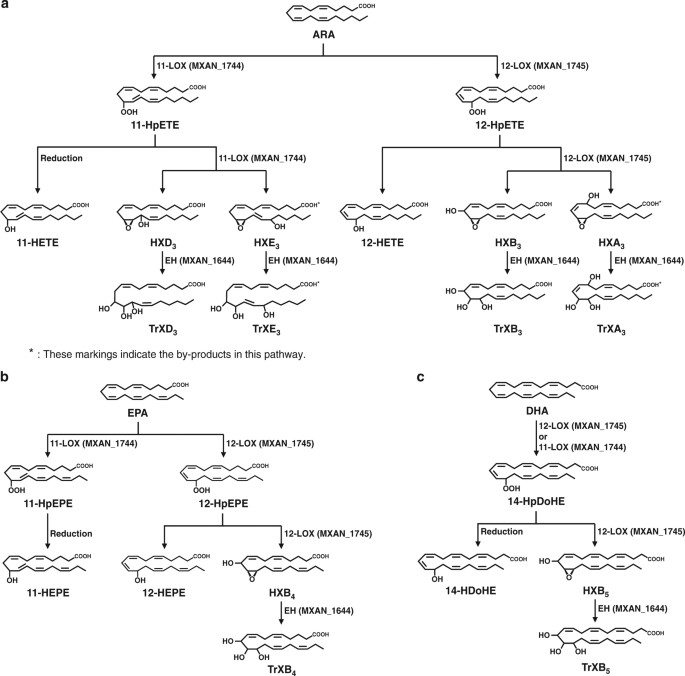
Hepoxilins (HXs) and trioxilins
(TrXs) are involved in physiological processes such as inflammation,
insulin secretion and pain perception in human. They are metabolites of
polyunsaturated fatty acids (PUFAs), including arachidonic acid,
eicosapentaenoic acid and docosahexaenoic acid, formed by
12-lipoxygenase (LOX) and epoxide hydrolase (EH) expressed by mammalian
cells.
Here, we identify ten types of HXs and TrXs, produced by the
prokaryote Myxococcus xanthus, of which six types are new, namely, HXB5, HXD3, HXE3, TrXB5, TrXD3 and TrXE3.
We succeed in the biotransformation of PUFAs into eight types of HXs
(>35% conversion) and TrXs (>10% conversion) by expressing M.
xanthus 12-LOX or 11-LOX with or without EH in Escherichia coli. We
determine 11-hydroxy-eicosatetraenoic acid, HXB3, HXB4, HXD3, TrXB3 and TrXD3
as potential peroxisome proliferator-activated receptor-γ partial
agonists. These findings may facilitate physiological studies and drug
development based on lipid mediators.
1946 syntynyt Tampereella
Ylioppilastutkinto 1964 Lempäälä
Lääketietaan kandidaatti 1966 Turun yliopisto
Lääketieteen lisensiaatti 1972 Turun Yliopisto
Dietetiikan opiskelu 1998 - 2001 Göteborgin Yliopisto
Eläkkeelle 2010

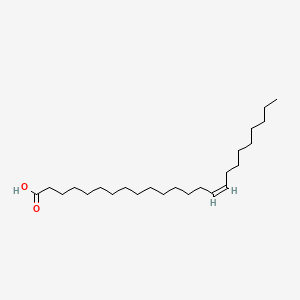
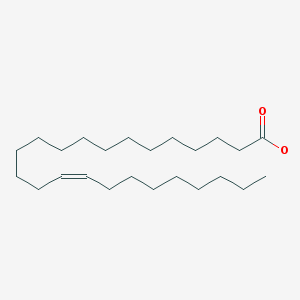 Tämä muoto kaavassa on sikäli edullinen että siihen voi verratt PUFA rsvahappojen kavoja ja sitten voi katsoa, vaikuttavatko PUFA-alueen entsyymit jotain tähän happoon. ja mitä. Tietysti tämä hahmo vaatii kyllä jonkin ympäristövaikutuksen( ympärilläolevien rasvahappojen vaikutuksen ) taipuakseen tuolla tavalla kulmassa - pohdin vain.